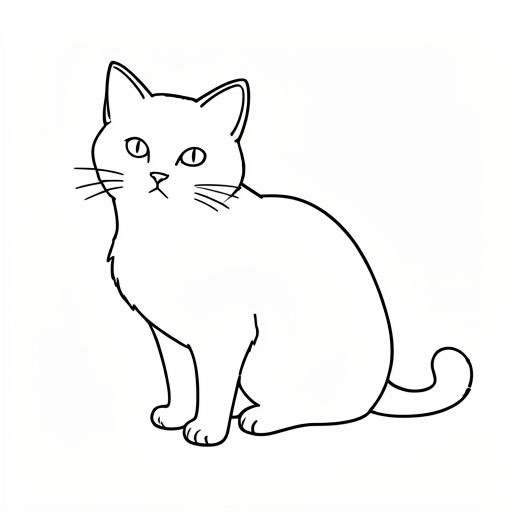
What the outline is actually doing
A colouring outline is not decoration. It is a boundary a child is trying to respect with a tool they do not fully control yet. The thicker the line, the more forgiving that boundary becomes, because a stray crayon stroke lands on the line rather than outside it.
This is why the same drawing can feel achievable to one child and impossible to another. Nothing about the subject changed — only the width of the margin for error.
The three weights, and who each is for
In practice three settings cover almost every group you will teach.
- Bold, roughly 6 to 8 points: ages three to six, and any child with reduced grip strength. The line itself absorbs the overshoot.
- Medium, roughly 4 to 5 points: ages six to nine. Enough precision to feel like real drawing, enough width to forgive a wobble.
- Fine, roughly 2 to 3 points: nine and up. Thin lines leave room for shading and blending, which is the point at that age.
Detail reduction beats thinning
A common mistake is to simplify a sheet by thinning its lines. That makes it harder, not easier — the shapes stay just as intricate but the boundaries get less visible.
The right move is to remove interior lines entirely. Fewer, larger closed shapes is what makes a sheet suitable for a younger hand. Thinning is a stylistic choice for older children, not an accessibility one.
Where grip strength changes the answer
Age bands are a starting point, not a rule. A seven-year-old recovering from a hand injury, or a child with hypermobility, may need the bold setting long past the age it is nominally for.
If you are choosing between two weights, pick the bolder one. A child who finds a sheet too easy will still finish it. A child who finds it too hard will stop.
If you only remember one thing
Match the line to the hand, not to the subject. The drawing does not care how thick its outline is; the child holding the crayon does.